
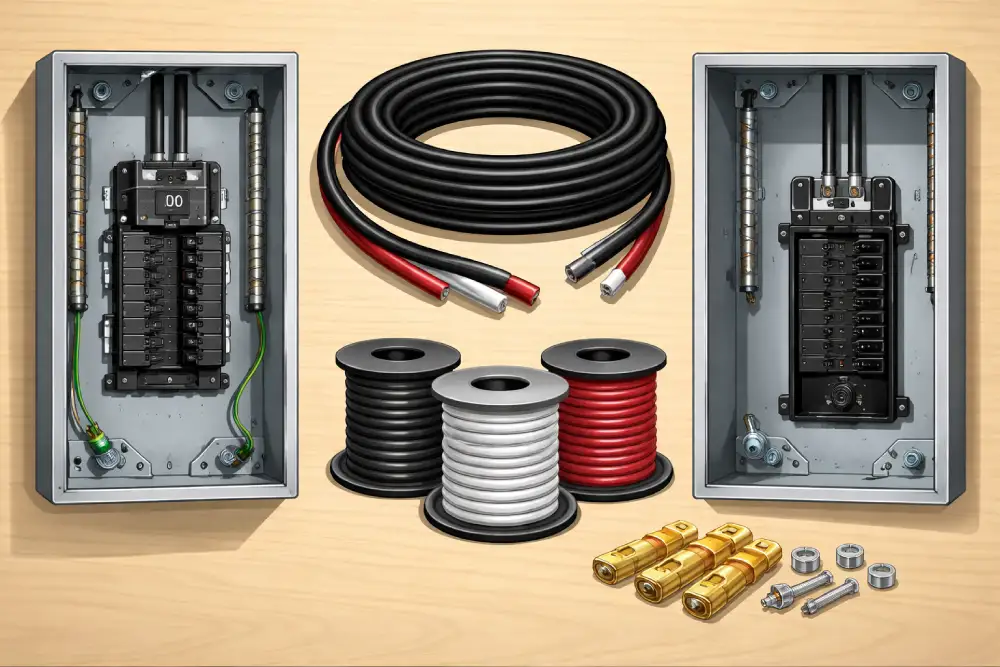
Alright, so you want to run a 100 amp sub panel and you just want someone to say the wire size without a whole thesis. I get it. Here is the clean way to think about it so you do not end up buying the wrong spool and hating your life later.
The common “default” answers people use
If you are feeding a 100 amp sub panel, these are the sizes you will hear constantly:
- Copper: usually #3 AWG copper for 100A feeders (common pick with 75°C terminations).
- Aluminum: usually #1 AWG aluminum for 100A feeders (also common with 75°C terminations).
The two things that actually change the wire size
1) What kind of wire is it
People say “#3 copper” like all copper is the same. It is not. THHN in conduit, SER cable, and other insulation types live in different parts of the code tables and real installs have different limits. Also your lugs might be rated 75°C, and that matters for which column you are allowed to use.
So when someone asks “what wire for 100 amps” the best comeback question is: Is it copper or aluminum, and is it THHN in conduit or a cable assembly like SER?
2) How far is the run
Distance is the silent killer. You can be technically code-legal on ampacity and still end up with annoying voltage drop if the run is long. That shows up as dim lights, motors that run hot, and weird performance that makes you question everything.
For short runs, the common sizes above are usually fine. For longer runs, you often upsize to keep voltage drop reasonable. The code has guidance around voltage drop, and a lot of electricians treat it as standard practice even when it is not written like a hard rule in every situation.
A simple cheat sheet that works in real life
If you want the bar-napkin version, here you go:
- Short run, typical setup: #3 copper or #1 aluminum
- Longer run: upsize one step, sometimes two, depending on distance and load
- Big continuous loads: pay attention to how the load is calculated so you are not cutting it close
Do not forget these sub panel basics
Since we are here, the sub panel mistakes I see people make all the time:
- Neutrals and grounds get separated in the sub panel. Neutrals float, grounds bond.
- Four-wire feeder. Two hots, neutral, equipment ground. Do not try to get cute with it.
- Breaker size matters. Your feeder sizing is tied to the overcurrent protection and the termination ratings.
So what should you buy
If you just want a solid normal answer for a typical 100A sub panel feeder: #3 copper or #1 aluminum is where most people land. Then you double check distance for voltage drop, and you confirm your terminations and wire type match the ampacity column you are using.
Studying for the journeyman exam?
Electrician Practice gives you timed drills, explanations, and weak-area practice so wire sizing questions stop feeling like a coin flip.