
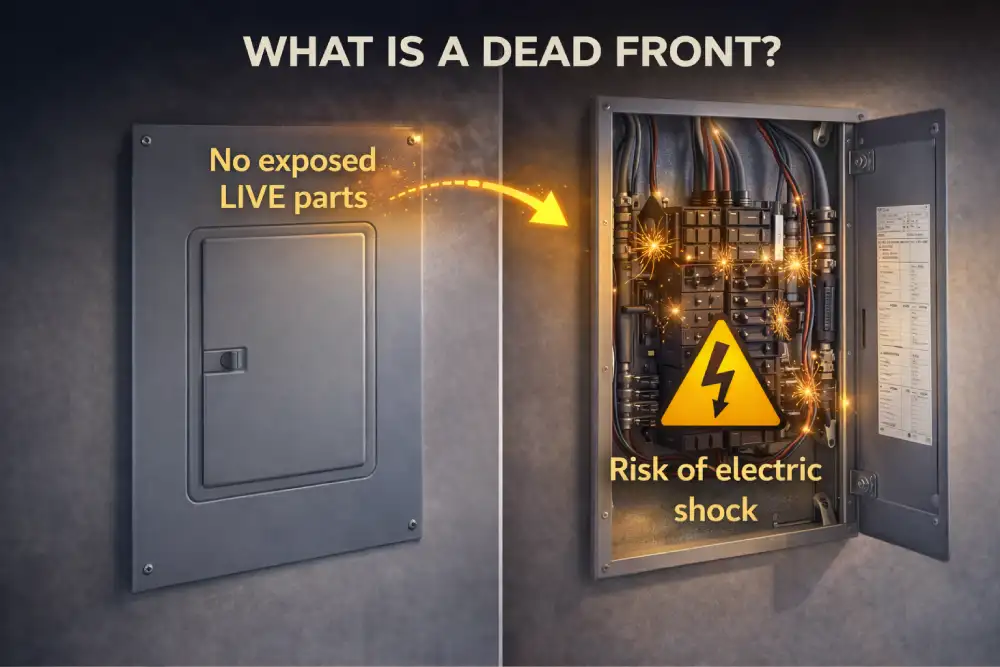
If you have ever heard someone on a job site say a panel needs to be dead front and wondered exactly what that means, you are not alone. It is one of those terms that gets thrown around a lot but does not always get explained.
What dead front actually means
A dead front panel is one where the front of the equipment has no exposed energized parts that someone could accidentally touch.
When you open a dead front panel and pull the cover off the breakers, the bus bars and live connections are still behind another barrier. You can see the breakers and flip them, but you cannot accidentally brush your hand against something energized just by opening the door.
The opposite of a dead front is a live front, where energized parts are exposed and accessible from the front of the equipment. You still see live front equipment in some older industrial setups but it is rare in modern work and the NEC has largely pushed everything toward dead front design.
Where the term shows up in the NEC
The NEC requires dead front construction in a lot of places. Panelboards are one of the most common. NEC 408.18 specifically requires panelboards to have a dead front.
Switchboards, motor control centers, and other distribution equipment have similar requirements depending on the section that covers them.
What it looks like in real life
Think about a standard residential load center. You open the door and see the breaker handles. You can flip breakers on and off no problem.
But the bus bars behind the breakers, the lugs at the top where the service conductors land, all of that is behind covers and barriers. You have to actually remove additional panels to get to those parts.
That is dead front construction doing its job. A homeowner can open that panel door and reset a tripped breaker without being in danger of touching anything that would hurt them.
Why it matters on the exam
Dead front comes up on the journeyman and master exam in a couple of ways.
Sometimes they ask you directly what the term means. Other times it shows up in questions about panelboard requirements or switchboard construction where knowing the NEC section behind it matters.
The key things to have locked in are that dead front means no exposed energized parts accessible from the front, it is required for panelboards under NEC 408.18, and it does not mean the equipment is turned off.
The quick version to remember
- Dead front means no exposed energized parts accessible from the front of the equipment
- The panel is still live, the parts are just behind barriers
- Required for panelboards under NEC 408.18
- The opposite is a live front, which is rare in modern installations
Studying for the journeyman exam?
Electrician Practice covers panelboard requirements, NEC definitions, safety rules, and everything else on the exam with realistic practice questions and clear explanations.