
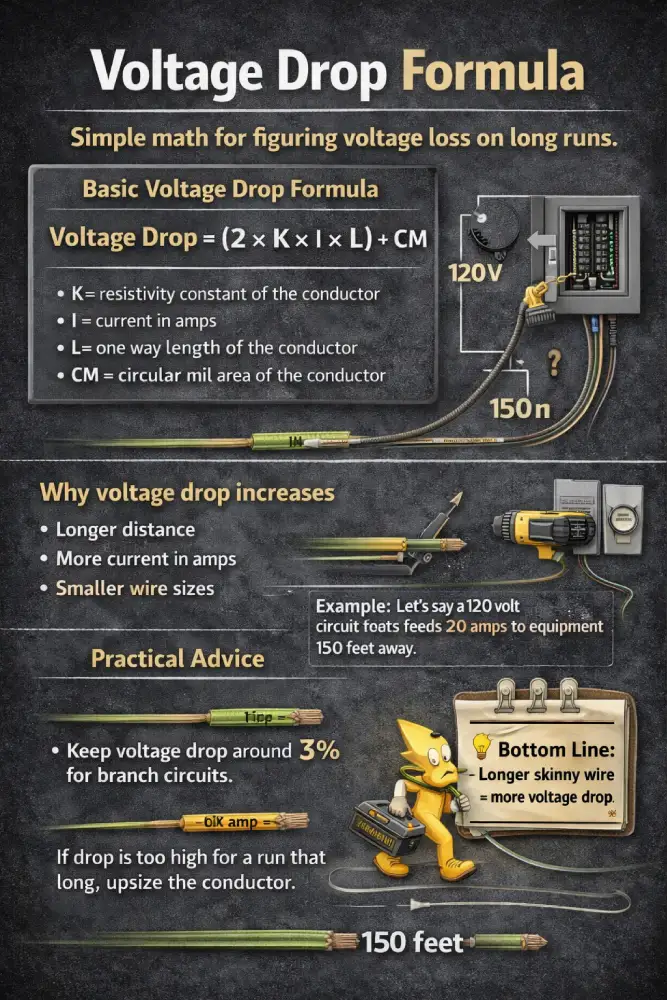
The voltage drop formula sounds like one of those things electricians only see in textbooks. In reality, it shows up all the time when runs start getting long.
You do not always have to calculate it by hand, but understanding what the formula means makes a lot of wiring decisions easier.
Voltage drop is simply the loss of voltage that happens as electricity travels through a conductor. The farther the electricity travels, the more resistance it runs into.
The basic voltage drop formula
For a simple single phase circuit, the voltage drop formula usually looks like this:
Voltage Drop = (2 × K × I × L) ÷ CM
That looks intimidating at first, but each part is just representing something physical in the circuit.
- K = resistivity constant of the conductor
- I = current in amps
- L = one way length of the conductor
- CM = circular mil area of the conductor
The number 2 is there because current travels out and back on a single phase circuit. So the effective conductor length is double the one way distance.
Why the formula works
The voltage drop formula is basically measuring how much resistance the wire adds to the circuit. More resistance means more voltage gets used up before it reaches the load.
Three things push the voltage drop higher.
- Longer conductor runs
- Higher current
- Smaller wire sizes
If you increase any of those factors, voltage drop increases. If you increase wire size, the drop goes down because resistance drops.
A quick example
Let’s say you have a 120 volt circuit feeding equipment 150 feet away. The load is pulling about 20 amps.
If the conductor is too small, the voltage that actually arrives at the load may be noticeably lower than 120 volts.
That is voltage drop in action. If the drop gets too high, equipment performance can suffer.
Electricians usually solve this by increasing the conductor size. Bigger wire means less resistance, which means less voltage loss.
Why calculators are common now
Most electricians are not pulling out circular mil math on a jobsite anymore. Voltage drop calculators handle the heavy lifting in seconds.
You enter the voltage, current, distance, and wire size, and the calculator tells you the drop percentage.
But the calculator is still using the same voltage drop formula under the hood.
The 3 percent rule electricians talk about
You will often hear electricians talk about keeping voltage drop around 3 percent for branch circuits. That recommendation helps equipment operate the way it was designed.
The combined feeder and branch circuit recommendation is often around 5 percent total. Those numbers are practical guidelines used across the industry.
Where exam questions show up
Licensing exams love voltage drop questions because they combine wiring knowledge with basic electrical math.
Sometimes the question asks you to calculate the drop. Other times it simply expects you to recognize when the conductor size needs to be increased.
If the problem mentions a very long conductor run, that is usually your signal that voltage drop matters.
The easy way to think about it
Electricity does not like long skinny conductors. The farther it travels through a small wire, the more voltage gets lost along the way.
The voltage drop formula is just a way of measuring that loss so electricians can decide whether the wire size needs to increase.
Once you see it that way, the formula stops feeling like random math and starts feeling like common sense.
Voltage drop questions show up often on electrician licensing exams
Electrician Practice helps you drill the calculation questions, NEC tables, and conductor sizing rules that appear most often on electrician exams.