
Voltage drop is something electricians start thinking about when wire runs get long.
Electricity does not move through conductors perfectly. Every wire has resistance, and that resistance causes some voltage to be lost along the way.
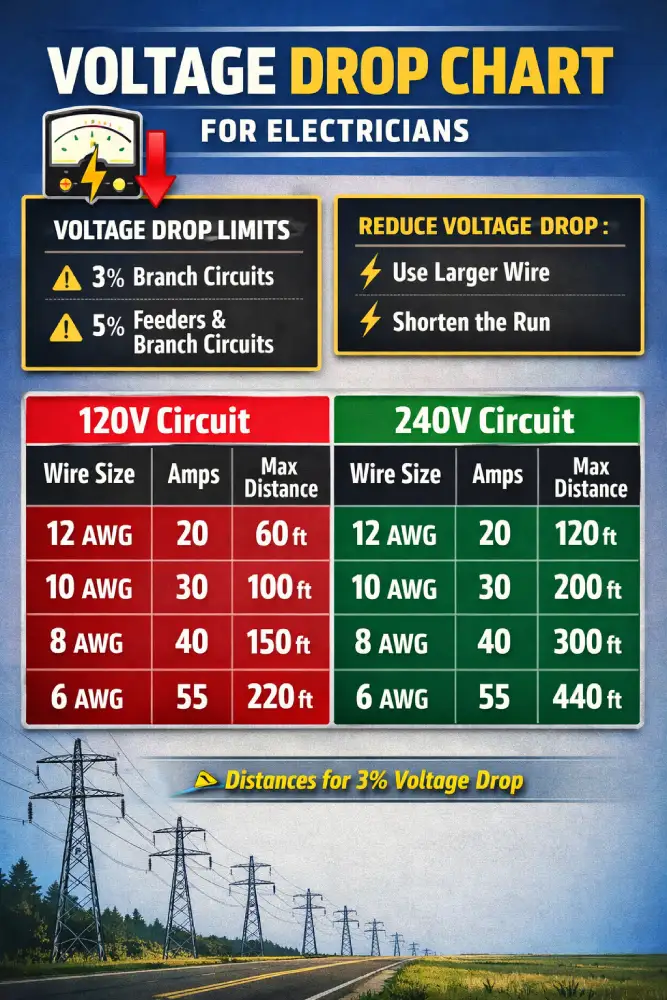
A voltage drop chart helps electricians estimate how much voltage will be lost across a conductor over distance.
What voltage drop actually means
Voltage drop is the reduction in voltage between the power source and the electrical load.
As current travels through a conductor, some energy is lost as heat due to resistance. That loss shows up as a lower voltage at the end of the circuit.
On short runs the difference is usually small. On long runs it can become a real problem.
Why electricians care about voltage drop
When voltage drops too much, equipment may not work properly.
Motors may run hotter, lights may dim, and electronics may behave unpredictably.
That is why electricians often increase conductor size when running long circuits.
Larger wires have lower resistance, which reduces voltage drop.
The common rule electricians remember
The NEC recommends keeping voltage drop within certain limits for efficient operation.
- 3 percent maximum for branch circuits
- 5 percent total for feeders and branch circuits combined
These numbers are recommendations rather than strict code violations, but most electricians try to stay within them.
How a voltage drop chart helps
A voltage drop chart shows how conductor size, current, and distance affect voltage loss.
Instead of doing a full calculation every time, electricians can quickly estimate voltage drop by looking at the chart.
It becomes especially useful when planning feeders, outdoor circuits, or long runs across large buildings.
Where voltage drop appears on exams
Electrician licensing exams often include voltage drop questions.
These questions usually test your understanding of Ohm’s law and how conductor resistance affects voltage.
Once you understand the relationship between distance, current, and conductor size, the questions become much easier to work through.
Voltage drop calculations appear on electrician licensing exams
Electrician Practice drills the calculations and NEC concepts that appear most often on licensing tests so you can solve these questions quickly.