
Voltage drop is one of those topics that sounds complicated until someone explains it in normal language. Once you see the formula a few times it becomes pretty straightforward.
Voltage drop happens because every conductor has resistance. As current flows through a wire, some voltage is lost along the length of that conductor.
The longer the wire and the higher the current, the bigger the voltage drop becomes.
Why electricians care about voltage drop
Too much voltage drop can cause equipment to perform poorly. Motors can run hotter, lights can dim, and electronics may not operate correctly.
Because of this, electricians try to keep voltage drop within reasonable limits.
A common recommendation is:
- 3% maximum voltage drop on a branch circuit
- 5% total voltage drop for feeder plus branch circuit
Those numbers show up frequently on licensing exams.
The basic voltage drop formula
One of the most common formulas electricians use is:
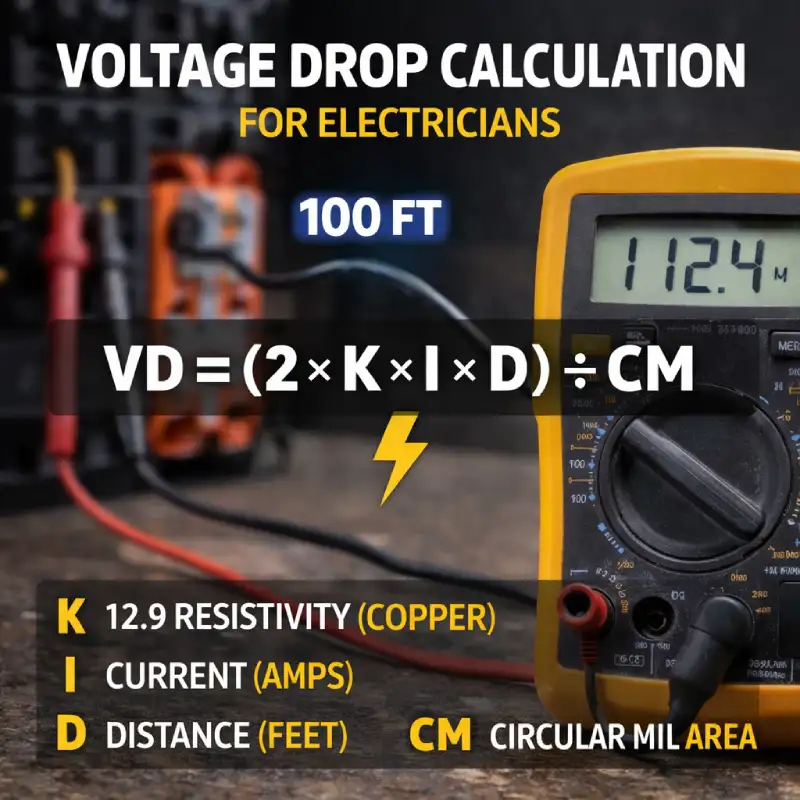
VD = (2 × K × I × D) ÷ CM
Where:
- VD = voltage drop
- K = resistivity constant of the conductor
- I = current in amps
- D = one-way distance of the circuit
- CM = circular mil area of the conductor
For copper conductors, the constant K is commonly 12.9.
A simple example
Let’s say you have a 120 volt circuit that runs 100 feet and carries 20 amps using #12 copper wire.
As the current travels through the conductor, resistance in the wire causes some voltage to be lost.
If the voltage drop becomes too large, electricians may increase the wire size to reduce resistance.
How electricians reduce voltage drop
There are two common ways to fix voltage drop problems.
- Increase the wire size
- Reduce the length of the circuit
Larger conductors have lower resistance, which helps maintain voltage over longer distances.
The exam trick people miss
Journeyman exam questions often give you distance and current and ask for the voltage drop or conductor size.
The most common mistake is forgetting that the formula uses the one-way distance of the circuit.
That detail trips up a lot of people.
Studying for the journeyman exam?
Electrician Practice gives you timed drills, explanations, and calculation walkthroughs so voltage drop questions stop feeling like math class.