
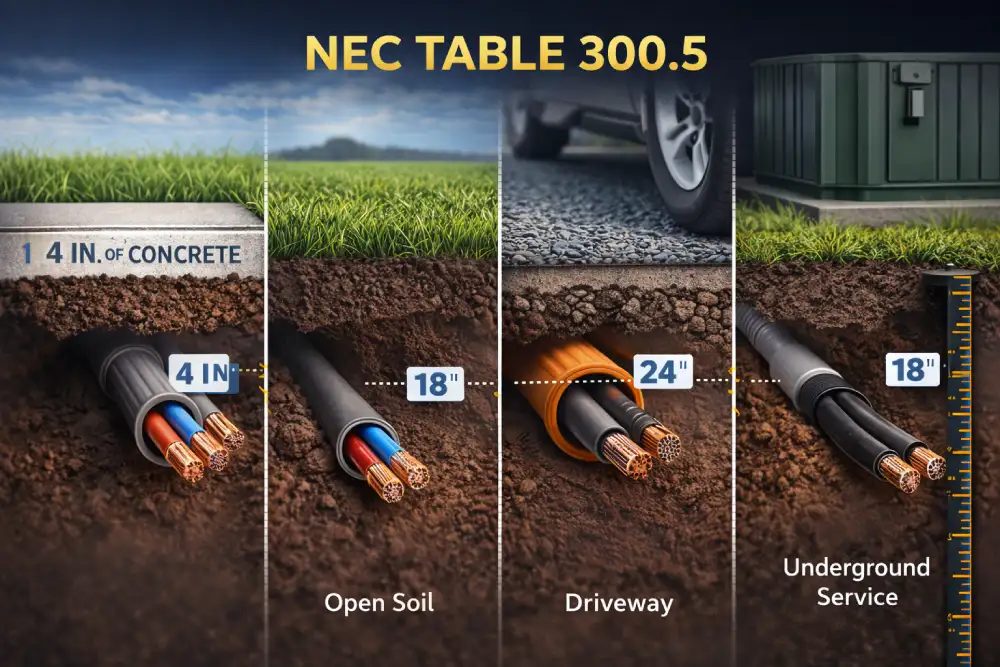
Any time you are running wire underground, NEC Table 300.5 is the table you need. It tells you the minimum depth you have to bury different wiring methods depending on where they are installed and what is above them.
This table comes up constantly on the journeyman exam and it is worth understanding the logic behind it, not just memorizing numbers.
How the table is set up
Table 300.5 has columns across the top for different wiring methods and rows down the side for different location types. You find your wiring method, find your location, and the intersection gives you the minimum cover required.
Cover means the distance from the top of the conduit or cable to the finished grade above it.
The common burial depths to know
Here are the numbers that show up most often on the exam for 120 volt or 240 volt residential circuits:
- Direct buried cable (like UF cable): 24 inches
- Rigid metal conduit (RMC) or intermediate metal conduit (IMC): 6 inches
- Rigid PVC conduit (Schedule 80 or Schedule 40): 18 inches
- THHN in PVC conduit under a driveway: 24 inches
- THHN in RMC under a driveway: 6 inches
What changes the depth requirement
A few things can reduce the required burial depth and this is where exam questions get tricky.
If the circuit is a residential branch circuit rated 120 volts or less, protected by a GFCI and limited to 20 amps, the burial depth for direct buried cable drops to 12 inches instead of 24 inches.
Installing a 2 inch concrete pad over the wiring can also reduce the required depth by a few inches depending on the wiring method. The concrete counts as additional protection.
Under driveways and roads
When you are crossing under a road or driveway the depths change again. For most wiring methods under a street or highway, you are looking at 24 inches minimum. Under a residential driveway the requirements depend on what is in the conduit and what type of conduit you are using.
Metal conduit under a residential driveway can be as shallow as 6 inches because the conduit protects the wire from physical damage.
Why the wiring method matters so much
The whole logic of the table comes down to protection. Metal conduit is tough. It takes a lot to damage it with a shovel or a stake. Direct buried cable has nothing around it except dirt, so it needs to be deeper to get the same level of protection from someone digging nearby.
Once you understand that, the table makes a lot more sense and is easier to work through on the exam.
The quick version to remember
- Direct buried cable: 24 inches general, 12 inches if GFCI protected at 120V/20A or less
- PVC conduit: 18 inches
- RMC or IMC: 6 inches
- Depths can change under driveways, roads, and with concrete cover
- Always measured from top of wiring method to finished grade
Studying for the journeyman exam?
Electrician Practice has questions covering NEC tables, underground wiring, conduit fill, and everything else on the exam with realistic practice questions and clear explanations.