
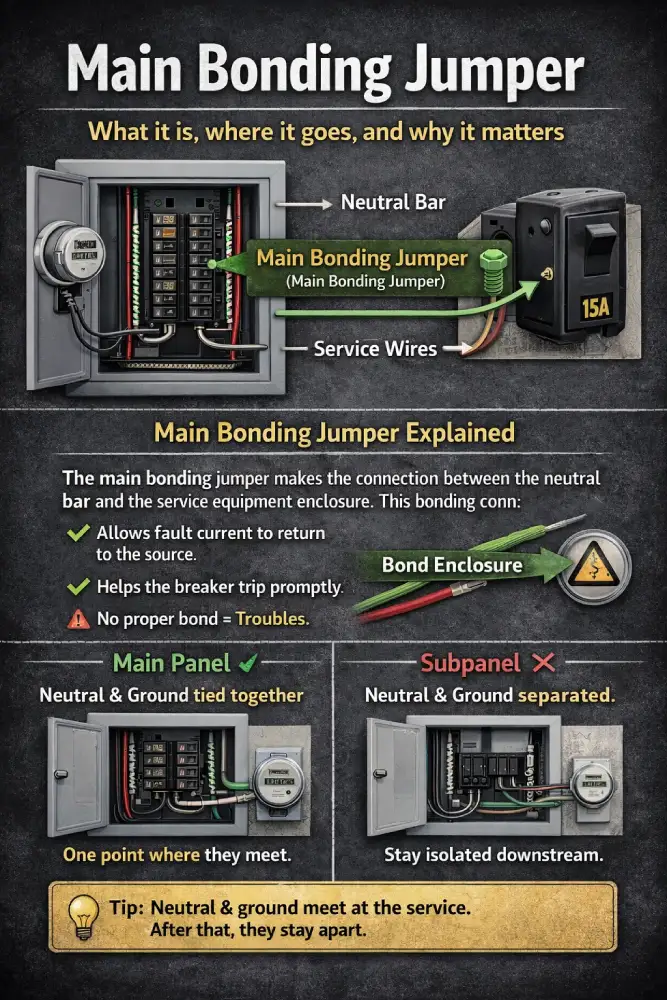
The main bonding jumper is one of those terms that sounds more complicated than it really is. Once somebody explains it like a normal person, it clicks pretty fast.
The short version is this. The main bonding jumper is the connection that ties the grounded conductor, meaning the neutral, to the equipment grounding side at the service disconnect.
That bond matters because it gives fault current a low-impedance path back to the source so the breaker can trip. No bond, no clean fault path, and now you are asking for trouble.
What the main bonding jumper actually does
Think of the main bonding jumper as the link that connects the neutral bar to the metal enclosure and the equipment grounding path in service equipment.
At the service, that connection is supposed to happen. That is the one spot where neutral and ground come together.
After that point, they need to stay separated in downstream panels. That is where a lot of people get burned on exams and in the field.
Where the main bonding jumper is located
In a lot of service panels, the main bonding jumper is just a green bonding screw or a bonding strap. It might not even look dramatic. It just looks like one little part sitting there quietly causing a lot of exam questions.
But that little piece is what bonds the service grounded conductor to the enclosure and the equipment grounding conductors at the service disconnecting means.
If you are in the main service equipment, the bond belongs there. If you are in a subpanel, that bond does not belong there.
Main panel vs subpanel
This is the part people mix up constantly. In the main service disconnect, neutral and ground are bonded. In a subpanel, neutral and ground are isolated.
So if you see a bonding screw in a subpanel, that should set off alarm bells in your head right away. That is a classic wrong setup and a classic exam trap.
- Main service equipment → bond neutral and ground
- Subpanel → keep neutral isolated from ground
If you lock that in, you already avoid one of the easiest mistakes people make.
Why the main bonding jumper matters for safety
Let’s say a hot conductor faults to a metal panel enclosure. You want that fault current to take a good low-impedance path back so the overcurrent device opens fast.
The main bonding jumper helps make that happen at the service. It is part of what ties the fault current path together.
Without that proper bond, metal parts that should clear a fault can stay energized longer than they should. That is obviously bad news.
Why people confuse bonding and grounding
A lot of this topic gets muddy because people use grounding and bonding like they mean the exact same thing. They do not.
Grounding is about connecting to earth. Bonding is about connecting metal parts together so they stay at the same potential and provide an effective fault current path.
The main bonding jumper is a bonding connection. It is not just there to make the panel feel official. It has a real job.
What exams love to ask
Licensing exams love the main bonding jumper because it is easy to turn into a trick question. They will ask where it is installed, what it connects, or whether it belongs in a subpanel.
Another favorite is showing a diagram with neutral and ground tied together in the wrong place and asking what is wrong with the installation.
If you remember that the main bonding jumper belongs at the service disconnect and not downstream, you are in pretty good shape.
The simple way to remember it
Here is the easy version you can keep in your head. Neutral and ground meet once at the service. After that, they break up and stop hanging out together.
That one connection at the service is where the main bonding jumper comes in. It is the piece that makes that bond happen.
Once you think about it that way, the whole topic stops feeling so weird.
Grounding and bonding questions trip up a lot of people on electrician exams
Electrician Practice helps you drill the grounding, bonding, and service equipment rules that show up over and over so you stop second-guessing main panel vs subpanel questions.