
The kitchen has more GFCI requirements than almost any other room in the house. Water and electricity are constantly in close proximity and the NEC reflects that. If you are wiring a kitchen or studying for the exam, here is exactly what needs GFCI protection and where the rules come from.
Countertop receptacles
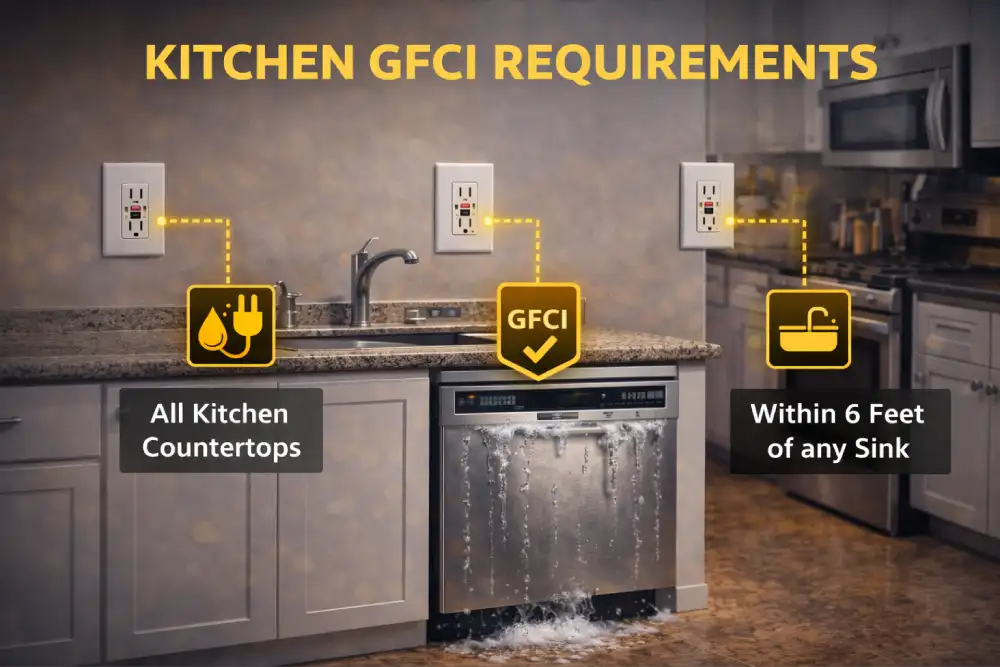
Any receptacle that serves a countertop surface in a kitchen requires GFCI protection. That is the big one and it covers pretty much every outlet you are going to install along the counter whether it is near the sink or at the other end of the kitchen.
It does not matter how far the outlet is from the sink. If it serves the countertop it needs GFCI protection, full stop.
Receptacles within 6 feet of a sink
On top of the countertop rule, any receptacle within 6 feet of the top inside edge of a kitchen sink requires GFCI protection regardless of whether it serves a countertop surface.
So if you have a receptacle on a wall near the sink that is not technically serving a countertop, if it is within 6 feet of the sink it still needs GFCI.
The dishwasher
As of the 2020 NEC, dishwashers in dwelling units require GFCI protection under NEC 210.8(D). This is a newer requirement that a lot of electricians still are not aware of.
For a hardwired dishwasher that means a GFCI breaker at the panel. For a cord and plug connected dishwasher you can use a GFCI receptacle under the sink or a GFCI breaker.
Refrigerators and other dedicated appliance circuits
This one surprises people. A refrigerator receptacle in a kitchen does not automatically require GFCI protection just because it is in a kitchen.
If the refrigerator receptacle is within 6 feet of the sink it does need GFCI. But if it is on a dedicated circuit on the other side of the kitchen away from the sink, it is not required. Most refrigerator receptacles end up being far enough away that GFCI is not required, though some electricians install it anyway to avoid any question.
What about the small appliance circuits
Kitchens require at least two 20 amp small appliance branch circuits to serve countertop receptacles. Both of those circuits need GFCI protection because all countertop receptacles in the kitchen require it.
The easiest way to handle this is with GFCI breakers at the panel for those two circuits, or by putting a GFCI receptacle at the first outlet on each circuit and using the load terminals to protect the rest of the outlets downstream.
The quick version to remember
- All countertop receptacles in a kitchen require GFCI protection
- Any receptacle within 6 feet of the top inside edge of a sink requires GFCI
- Dishwashers require GFCI protection under the 2020 and 2023 NEC
- Refrigerator receptacles do not automatically require GFCI unless they are within 6 feet of the sink
- Both small appliance branch circuits serving the countertop need GFCI
Studying for the journeyman exam?
Electrician Practice covers GFCI requirements, kitchen circuits, NEC code rules, and everything else on the exam with realistic practice questions and clear explanations.