
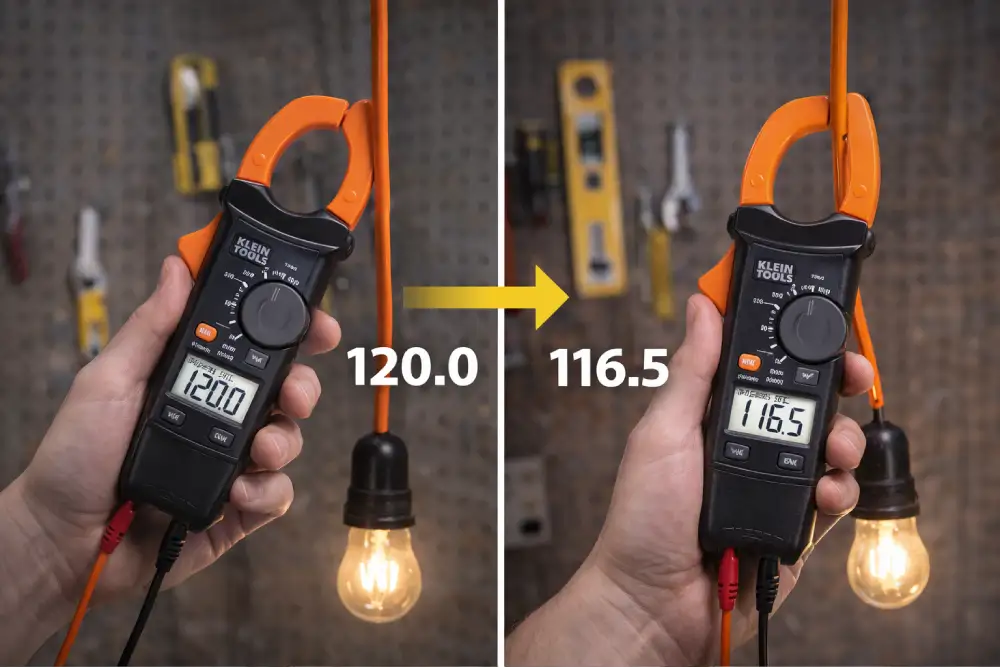
If you are trying to learn how to calculate voltage drop, the good news is it is not nearly as bad as it looks at first.
Most people get stuck because the formula looks ugly. Once you break it into pieces, it is really just a way to measure how much voltage gets lost as current travels through wire.
The big idea is simple. Longer runs, higher current, and smaller wire all make voltage drop worse.
What voltage drop actually means
Voltage drop is the difference between the voltage at the source and the voltage that actually reaches the load.
As current moves through a conductor, the conductor resists that flow a little. That resistance causes some voltage to get lost along the way.
So if you start with 120 volts at the panel, the load at the far end might not actually see the full 120 volts.
The basic single-phase formula
For a common single-phase circuit, the formula is:
Voltage Drop = (2 × K × I × L) ÷ CM
Here is what each part means:
- K = resistivity constant of the conductor
- I = current in amps
- L = one-way length of the run
- CM = circular mil area of the conductor
The reason there is a 2 in the formula is because current has to travel out and back in a single-phase circuit. So the total path is longer than just the one-way distance.
Step 1: Know your load current
First, figure out how much current the load is drawing. That is your I in the formula.
If the circuit is carrying 20 amps, then I = 20. Nothing fancy there.
If the question already gives you the amps, great. If not, you may need to find it from the load information first.
Step 2: Measure the one-way length
Next, figure out the one-way length of the conductor run. That is your L.
If the load is 150 feet away, then L = 150. Do not double it yourself if you are using the single-phase formula above, because the formula already handles that with the 2 in front.
This is one place where people mess up on exams. They double the distance and then also use the 2 in the formula, which throws the whole answer off.
Step 3: Pick the conductor size
Now you need the conductor size so you can get the circular mil area, or CM.
Different wire sizes have different circular mil areas. Bigger wire means more circular mil area, which means less resistance and less voltage drop.
For example, 10 AWG copper has a much smaller circular mil area than 4 AWG copper, so 10 AWG will have more voltage drop on the same run and load.
Step 4: Use the right K value
K is the resistivity constant for the conductor material. The common quick values people use are:
- Copper = 12.9
- Aluminum = 21.2
Aluminum has a higher K value, which means more resistance than copper at the same size. That is why aluminum usually needs a larger conductor size to perform similarly.
Step 5: Plug the numbers into the formula
Let’s do a simple example. Say you have:
- 20 amps
- 150 feet one-way
- 10 AWG copper
- CM for 10 AWG = 10,380
- K = 12.9 for copper
Plug that into the formula:
Voltage Drop = (2 × 12.9 × 20 × 150) ÷ 10,380
Work through it step by step:
- 2 × 12.9 = 25.8
- 25.8 × 20 = 516
- 516 × 150 = 77,400
- 77,400 ÷ 10,380 ≈ 7.46 volts
So the voltage drop is about 7.46 volts.
Step 6: Turn it into a percentage
Once you have the voltage drop in volts, you usually want the percentage too.
The formula for that is:
Voltage Drop % = (Voltage Drop ÷ System Voltage) × 100
If this is a 120-volt circuit:
(7.46 ÷ 120) × 100 ≈ 6.22%
That is a pretty noticeable drop. A lot of electricians would look at upsizing the conductor there.
What number are you usually aiming for
A common recommendation is about 3 percent voltage drop on a branch circuit and about 5 percent total for feeder plus branch circuit combined.
Those numbers are practical targets that help equipment run the way it should. They are not just random numbers people made up to sound smart.
So if your answer comes out well above that, it is usually a sign to look at a larger conductor.
What electricians do when the drop is too high
If the voltage drop comes out too high, the usual fix is upsizing the wire.
Bigger conductor means more circular mil area. More circular mil area means less resistance. Less resistance means less voltage drop.
That is why long runs often end up with larger wire than the bare minimum ampacity alone would suggest.
Where people mess this up on exams
Exam questions love voltage drop because people panic when they see a formula. Usually the mistakes are pretty basic.
- Using the wrong conductor material
- Using the wrong circular mil area
- Doubling the distance twice
- Forgetting to convert the result into a percentage
If you go one step at a time, it is really not that bad. Most wrong answers come from rushing, not from the math being impossible.
The simple way to think about it
If you want the bar version, here it is. Voltage drop is just the wire eating up some of your voltage on the trip.
The farther the run, the smaller the wire, and the higher the amps, the more it eats. So when the run gets long, check the math and do not assume the minimum wire size is automatically good enough.
Voltage drop questions show up all the time on electrician exams
Electrician Practice helps you drill voltage drop, conductor sizing, NEC tables, and the calculation questions that trip people up over and over.