
Grounding electrode conductor sizing is one of those things that confuses a lot of people, including guys who have been in the trade for a while. The NEC has a specific table for it and the logic behind it is pretty straightforward once someone walks you through it.
What is the grounding electrode conductor
The grounding electrode conductor, or GEC, is the wire that connects your service panel to the grounding electrode system. That could be a ground rod, a concrete encased electrode, a water pipe, or whatever grounding electrode you are using at that service.
It is not the same as an equipment grounding conductor. The GEC ties the system to the earth. The equipment grounding conductor is what bonds metal parts of equipment together and carries fault current back to the panel.
The table to use: NEC Table 250.66
To size the GEC, you go to NEC Table 250.66.
The table works off the size of the largest service entrance conductor, not the breaker size. You find the size of your service entrance conductor on the left side of the table and it tells you the minimum GEC size on the right.
Here are some common examples for copper service entrance conductors:
- 2 AWG or smaller service entrance conductor → 8 AWG copper GEC
- 1 AWG or 1/0 AWG → 6 AWG copper GEC
- 2/0 AWG or 3/0 AWG → 4 AWG copper GEC
- Over 3/0 AWG up to 350 kcmil → 2 AWG copper GEC
- Over 350 kcmil up to 600 kcmil → 1/0 AWG copper GEC
- Over 600 kcmil up to 1100 kcmil → 2/0 AWG copper GEC
- Over 1100 kcmil → 3/0 AWG copper GEC
What about the ground rod specifically
Here is where a lot of people get tripped up on the exam.
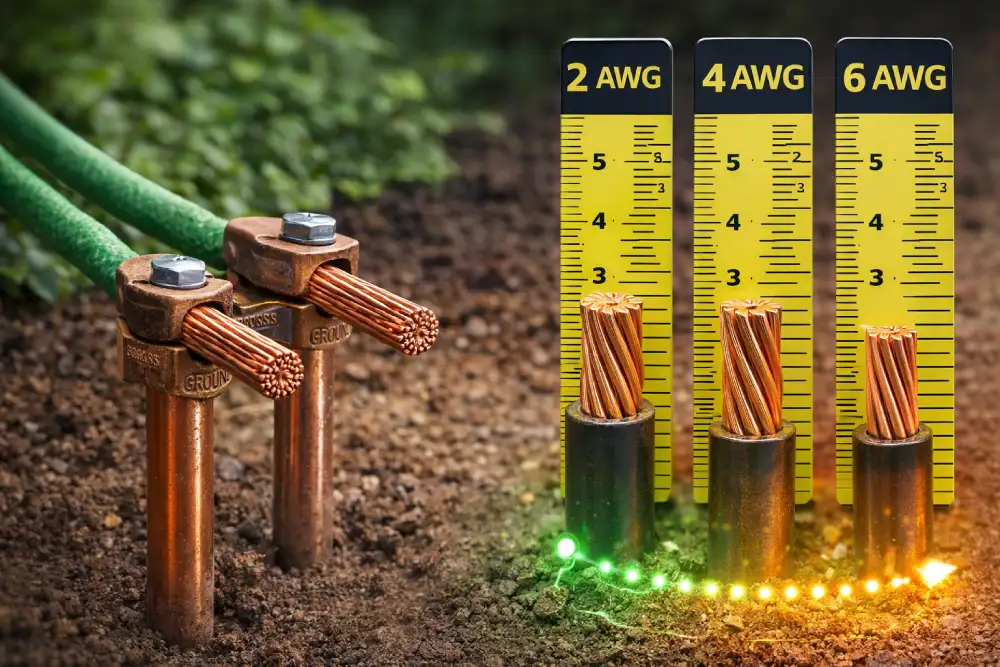
When the grounding electrode is a ground rod or a concrete encased electrode, the GEC does not need to be larger than 6 AWG copper. That is covered under NEC 250.66(A).
So even if Table 250.66 tells you that you need a 2 AWG GEC based on your service size, if you are running that conductor to a ground rod the maximum required size is 6 AWG copper.
That seems backwards at first but it makes sense when you understand that a ground rod has limitations on how much fault current it can actually handle anyway.
Aluminum vs copper GEC
You can use aluminum for the GEC but there are restrictions. Aluminum cannot be used within 18 inches of the earth and cannot be used where it might be subject to corrosive conditions. Most guys just use copper to keep it simple.
The quick version to remember
- Use NEC Table 250.66 to size the GEC
- The table is based on the largest service entrance conductor, not the breaker
- GEC to a ground rod or concrete encased electrode: 6 AWG copper maximum required
- The GEC never has to exceed 3/0 AWG copper no matter how big the service is
Studying for the journeyman exam?
Electrician Practice covers grounding, bonding, NEC tables, and everything else on the exam with realistic practice questions and clear explanations.