
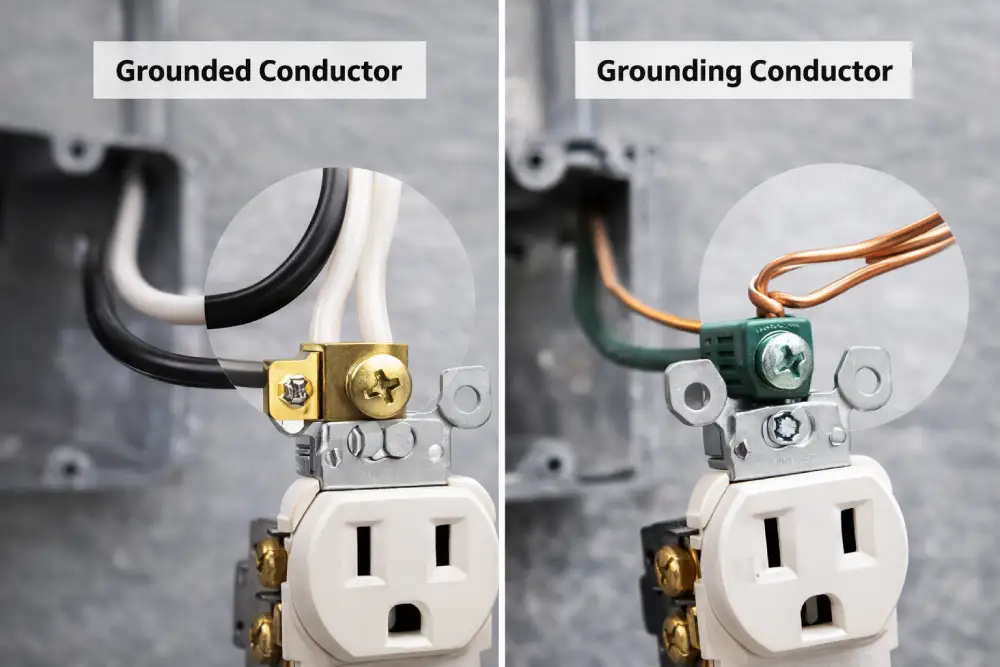
The difference between a grounded conductor vs grounding conductor confuses a lot of people at first. Honestly, it sounds like the code book is messing with you on purpose.
The names are close enough that people mash them together, then they get to an exam question and suddenly everything feels blurry.
The good news is this gets way easier once you stop looking at the words and start looking at the job each conductor is doing.
What is the grounded conductor
The grounded conductor is usually the neutral. It is intentionally connected to ground at the service, which is why it is called grounded.
Its normal job is to carry current during regular circuit operation. That is the big thing to remember. Under normal conditions, the grounded conductor is part of the return path for current.
So if someone says grounded conductor, your brain should usually go straight to neutral.
What is the grounding conductor
The grounding conductor is different. This is the equipment grounding conductor, usually just called the ground.
Its job is not to carry normal return current during everyday operation. Its job is to provide a low-impedance fault path if something goes wrong.
So if a hot wire touches a metal enclosure, the grounding conductor helps fault current get back fast enough to trip the breaker.
The simple version
If you want the bar version of this, here it is.
- Grounded conductor = neutral = normally carries current
- Grounding conductor = ground = carries fault current when things go sideways
That is not the whole chapter of the NEC, but it gets you about 90 percent of the way there for most conversations and test questions.
Why the names throw people off
This is where people get annoyed. The grounded conductor is the neutral, and the grounding conductor is the ground. So the one with grounded in the name is not the same thing as the one most people call ground.
Cool. Very helpful naming, right.
But once you lock in that the grounded conductor normally carries current and the grounding conductor is there for fault conditions, the wording stops being such a mess.
Where they connect
At the service disconnect, the grounded conductor and grounding conductor are bonded together. That is the one point where they meet.
Downstream from that, like in subpanels, they need to stay separated. That is one of the biggest exam traps in this whole topic.
If you tie neutral and ground together again downstream, now you are putting current where it does not belong. That is not what you want.
What each one does in normal operation
During normal operation, the grounded conductor may be carrying current back from the load. That is expected.
The grounding conductor should normally not be carrying current. If it is, that should make you stop and think about what is going on.
That difference is one of the easiest ways to separate the two in your head.
Common example that helps
Picture a standard 120-volt branch circuit. The hot sends power out to the load. The grounded conductor, meaning the neutral, brings current back during normal operation.
The grounding conductor is sitting there as a safety path. It is there in case a fault energizes metal parts that should not be energized.
So one is working in the normal loop. The other is there for protection if something goes wrong.
Where people blow easy exam questions
Licensing exams love asking grounded conductor vs grounding conductor because the wording is just close enough to make people rush and pick the wrong one.
They will ask which one normally carries current. Which one is connected to metal enclosures. Which one provides an effective fault current path. Which one is the neutral.
If you slow down for one extra second and ask yourself, are they talking about normal return current or fault protection, the answer usually becomes obvious.
The easy way to remember it
Here is the easiest memory trick. The grounded conductor is grounded on purpose and usually acts as the neutral return path. The grounding conductor is the safety conductor for equipment and fault current.
Neutral works in normal operation. Ground is there for abnormal conditions.
Once you think about it that way, the whole grounded conductor vs grounding conductor thing stops feeling like a word game.
Grounding and bonding questions show up all the time on electrician exams
Electrician Practice helps you drill neutral, ground, bonding, service equipment, and other code concepts that people mix up constantly on licensing tests.