
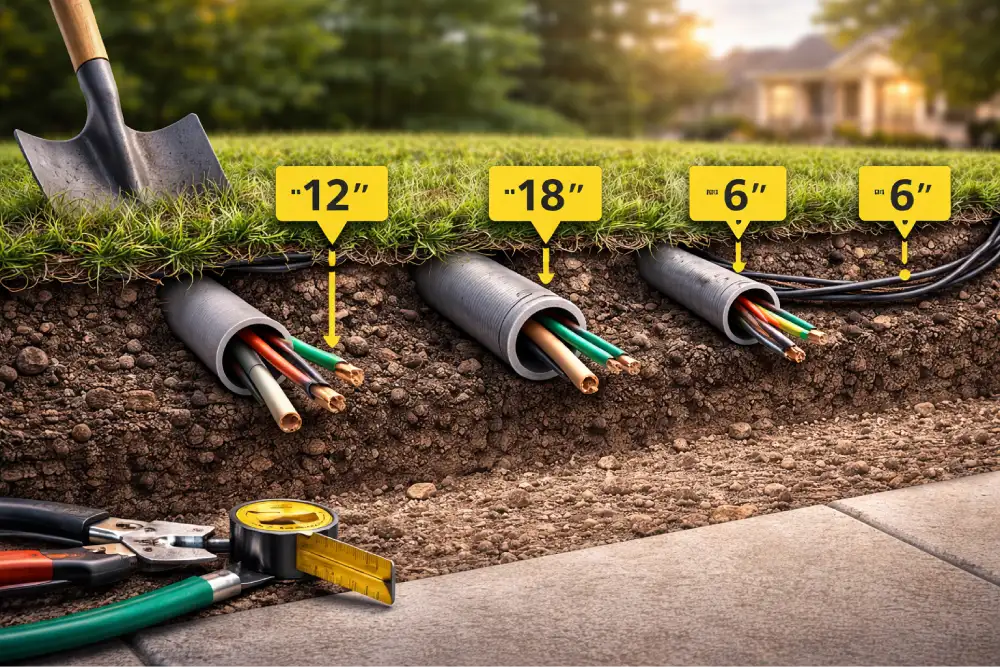
One of the most common questions on residential and commercial jobs is how deep underground electrical wiring needs to be buried. The answer is not one number. It depends on what you are burying and where it is going.
The NEC lays it all out in Table 300.5 and once you understand the logic behind it, it is pretty easy to work through in the field and on the exam.
Why burial depth matters
The whole point of burying wire deep enough is physical protection. Someone drives a fence post, plants a tree, or digs a garden bed and hits your wire. The deeper it is, the less likely that happens.
The NEC adjusts the required depth based on how much protection the wiring method already provides on its own. A wire inside rigid metal conduit is already well protected, so it does not need to be as deep. A direct buried cable with nothing around it needs more dirt above it for the same reason.
Burial depth by wiring method
Here are the standard minimum cover requirements from NEC Table 300.5 for circuits over 120 volts up to 600 volts in general locations:
- Direct buried conductors and cables (like UF-B): 24 inches
- Rigid PVC conduit: 18 inches
- Rigid metal conduit (RMC) or IMC: 6 inches
- THHN or THWN in any approved raceway: depth depends on raceway type
The residential GFCI exception
This one shows up on exams all the time and is worth knowing cold.
If you are running a residential branch circuit that is 120 volts or less, rated 20 amps or less, and it is GFCI protected, the burial depth for direct buried cable drops from 24 inches down to 12 inches.
That is a pretty common scenario on residential jobs, running power out to a shed or a backyard outlet. As long as it meets those three conditions, 12 inches is all you need for the direct buried cable.
Real world examples
Here is how this plays out on a typical residential job:
Say you are running a 20 amp GFCI protected circuit out to a detached garage using UF-B cable. That qualifies for the 12 inch depth reduction, so you can trench at 12 inches.
But if that same run is going to power a 240 volt outlet for a welder, it no longer qualifies for the reduction. Now you are back to 24 inches for direct buried cable, or you could put it in PVC conduit at 18 inches instead.
A lot of electricians just run PVC on anything 240 volt to keep the trench shallower and give the wire better protection while they are at it.
Under concrete and paved surfaces
Running under a sidewalk or patio slab changes things too. Two inches of concrete cover can reduce the required depth for some wiring methods.
And under a street or highway the depths increase significantly, usually 24 inches minimum regardless of wiring method, because the loads above ground are so much heavier.
The quick version to remember
- Direct buried cable: 24 inches standard, 12 inches for 120V/20A GFCI protected residential circuits
- PVC conduit: 18 inches
- RMC or IMC: 6 inches
- Depth is measured from top of wiring to finished grade
- More protection from the wiring method means shallower burial allowed
Studying for the journeyman exam?
Electrician Practice covers underground wiring, NEC tables, conduit systems, and everything else on the exam with realistic practice questions and clear explanations.