
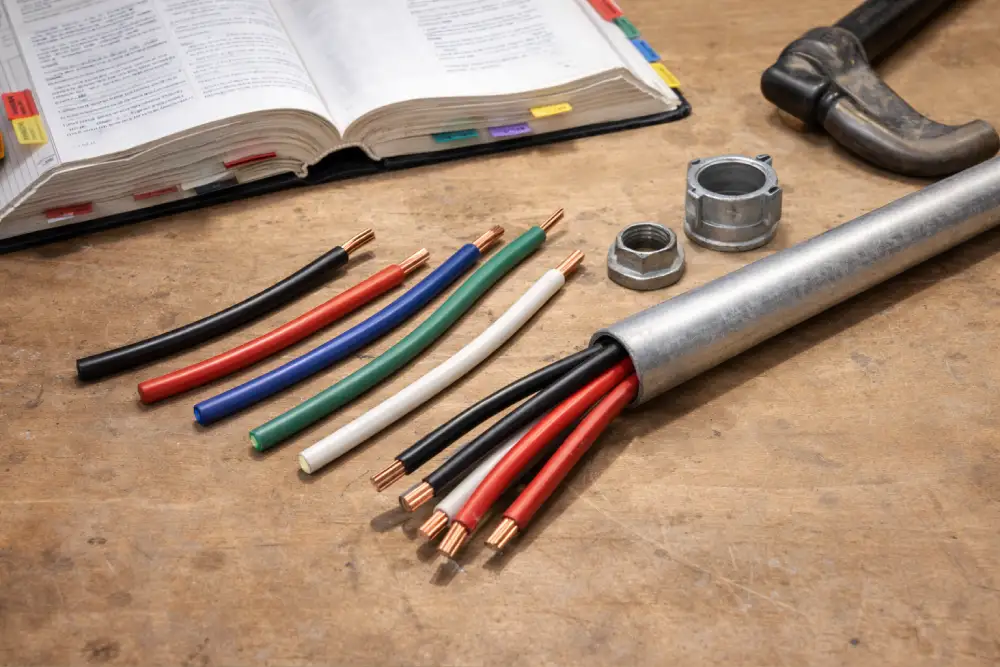
If conduit fill has ever made you stare at the NEC like it is written in another language, you are not alone. The good news is it is actually pretty mechanical once you know where the numbers live.
Most of the time when someone searches for a conduit fill chart they just want to know one thing. How many wires can I fit in this pipe without failing inspection.
The basic rule the NEC uses
The National Electrical Code limits how full a conduit can be. This keeps wires from overheating and makes pulling conductors possible without losing your sanity.
- 1 conductor: up to 53% of the conduit
- 2 conductors: up to 31%
- 3 or more conductors: up to 40%
In real installs you almost always land in the third category because feeders and branch circuits usually have several conductors.
Where the numbers actually come from
The code does not give you one giant chart that solves everything. Instead it spreads the information across a few tables in Chapter 9.
- Chapter 9 Table 1 explains the fill percentages
- Chapter 9 Table 4 gives the total conduit area
- Chapter 9 Table 5 lists the area of individual conductors
The process is basically this. Look up the wire area, add them together, then make sure the total is less than the allowed conduit fill area.
A quick real world example
Say you want to run several THHN conductors through EMT.
First you check Table 5 and find the cross sectional area of the conductor size you are using. Then you multiply that number by however many wires you have.
Next you open Table 4 and find the area of the conduit size you want to use. Take forty percent of that number if you have three or more conductors.
If your total wire area is smaller than that number, you are good. If not, you move up to the next conduit size.
The mistake people make on exams
The journeyman exam loves conduit fill questions because they force you to use the tables. The trap is usually forgetting which table you need first.
The correct order is almost always:
- Find conductor area
- Add up the conductors
- Find conduit area
- Apply the fill percentage
Once you follow that sequence the problem becomes pretty boring math.
Conduit fill questions show up constantly on the journeyman exam
Electrician Practice drills the NEC tables that show up most on licensing exams so you stop guessing and start recognizing patterns.