
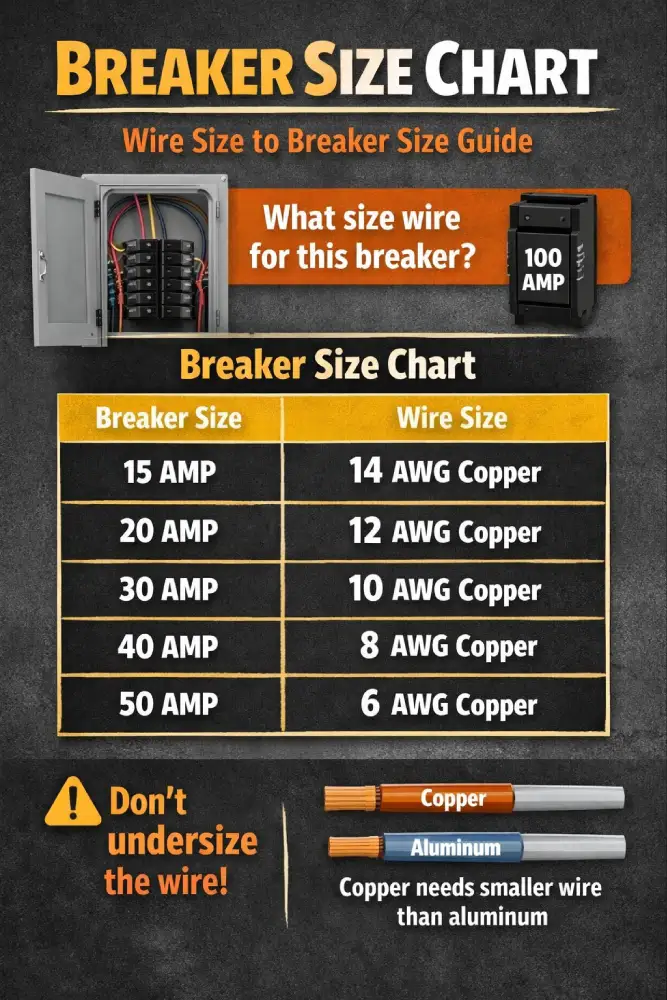
If you have ever looked up a breaker size chart, you were probably trying to answer a very normal electrician question. What size breaker goes with what size wire.
That question comes up all the time on jobs, in the classroom, and on licensing exams. It sounds simple, but this is where a lot of people get mixed up fast.
The short version is this. You do not size the wire to the breaker because it feels close enough. You match the conductor, the breaker, and the actual load using code rules.
What a breaker is actually doing
A breaker is there to protect the conductor. That is the big idea people need to lock in early.
A 20 amp breaker is not there because somebody likes the number 20. It is there because the conductor and the circuit are meant to be protected at that level.
If the wire is too small for the breaker, the wire can overheat before the breaker trips. That is where things get bad.
Common breaker size chart pairings
For a lot of everyday branch circuits, electricians memorize the common pairings and move on. These are the ones you see over and over.
- 15 amp breaker → 14 AWG copper
- 20 amp breaker → 12 AWG copper
- 30 amp breaker → 10 AWG copper
- 40 amp breaker → 8 AWG copper
- 50 amp breaker → 6 AWG copper
That is why 14 wire on a 20 amp breaker is such a classic wrong answer. People remember the breaker but forget the wire has to be protected.
Why this is not just a one chart answer every time
Here is where people get tripped up. A breaker size chart is helpful, but it is not magic.
You still have to think about conductor material, temperature rating, termination ratings, continuous load, and sometimes voltage drop. So the chart gets you in the ballpark, but code is what gives you the final answer.
That is why on exams they love giving you a simple looking question that actually has one extra detail hidden in it.
The 80 percent rule people talk about
This is one of those things that gets repeated a lot, sometimes in a sloppy way. So here is the bar-stool version.
For a continuous load, you generally size the circuit at 125 percent of the load. That is why people say a breaker should only be loaded to 80 percent for continuous use.
Example. If a load runs continuously at 16 amps, a 20 amp breaker makes sense because 16 amps is 80 percent of 20 amps.
Common residential examples
A few breaker sizes show up constantly in houses, so it helps to tie them to real circuits instead of just memorizing numbers.
- 15 amp breaker for lighting circuits in older or lighter-load areas
- 20 amp breaker for kitchen small-appliance circuits and bathroom receptacles
- 30 amp breaker for many electric dryers
- 40 to 50 amp breaker for many electric ranges and ovens
Once you connect the breaker sizes to real equipment, the numbers stick way better.
What exams love to test
On electrician exams, breaker size chart questions usually show up in a sneaky way. They might ask for the right breaker for a conductor, or the right conductor for a breaker, or they may throw in a continuous load and see if you catch it.
Another favorite move is mixing up 15 amp and 20 amp general-use branch circuits. If you know 14 copper goes with 15 amps and 12 copper goes with 20 amps, you already avoid one of the biggest easy mistakes.
The simple way to think about it
If you are standing there unsure, think about it like this. The breaker protects the wire. The wire has to be large enough for the load. The final answer has to make sense with the code rules.
That is really the whole game. A breaker size chart helps you move faster, but understanding why those pairings exist is what keeps you from blowing easy questions on the exam.
Breaker sizing questions show up all the time on electrician exams
Electrician Practice helps you drill the wire, breaker, and NEC pattern questions that come up the most so you stop second-guessing the basics.