
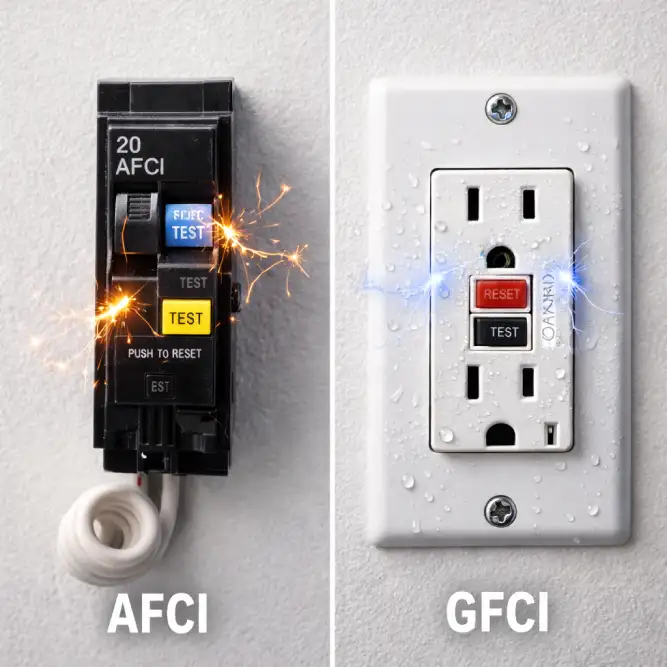
Alright, this one confuses a lot of people when they first start in electrical. Someone says you need an arc fault breaker. Someone else says it needs GFCI protection. Then someone says you need both and now everyone is arguing in the garage.
The easiest way to understand it is this. These two devices are protecting against completely different problems.
What a GFCI actually does
A GFCI protects people from shock.
It constantly compares the current going out on the hot with the current coming back on the neutral. If those numbers are different, it means electricity is leaking somewhere. That somewhere could be through water, through equipment, or through a human body.
If the difference is around 4 to 6 milliamps, the device trips almost instantly.
That is why you see them in places like:
- Bathrooms
- Kitchens
- Garages
- Outdoor receptacles
- Near sinks or water
Water and electricity do not mix well, so GFCI protection is there to protect people.
What an Arc Fault does
Arc fault protection is about preventing electrical fires.
An arc happens when electricity jumps through air between conductors or damaged wiring. That arc creates heat, sparks, and sometimes enough temperature to start a fire inside a wall.
Arc fault breakers monitor the electrical waveform and look for the signature of dangerous arcing. If they detect it, they trip the breaker.
That is why the code requires them in many living areas of a house like:
- Bedrooms
- Living rooms
- Dining rooms
- Hallways
- Closets
The mistake people make
The most common misunderstanding is thinking these two devices do the same thing. They do not.
A GFCI might not trip during a dangerous wiring arc. An arc fault breaker might not trip during a small ground leakage that could shock someone.
So sometimes the correct answer is both.
When you need both
Modern code often requires AFCI and GFCI protection on the same circuit. A common example is kitchen receptacles.
You might see this done by installing:
- A dual function breaker in the panel
- An AFCI breaker with a GFCI receptacle downstream
- A GFCI breaker combined with AFCI protection depending on the setup
The goal is simple. Protect the wiring from fires and protect people from shock.
Quick way to remember it
- GFCI: protects people from shock
- AFCI: protects wiring from fire
Once you remember that difference, most exam questions on this topic become pretty easy.
Studying for the journeyman exam?
Electrician Practice gives you timed drills, explanations, and weak-area practice so questions about GFCI, AFCI, and code rules stop feeling random.