
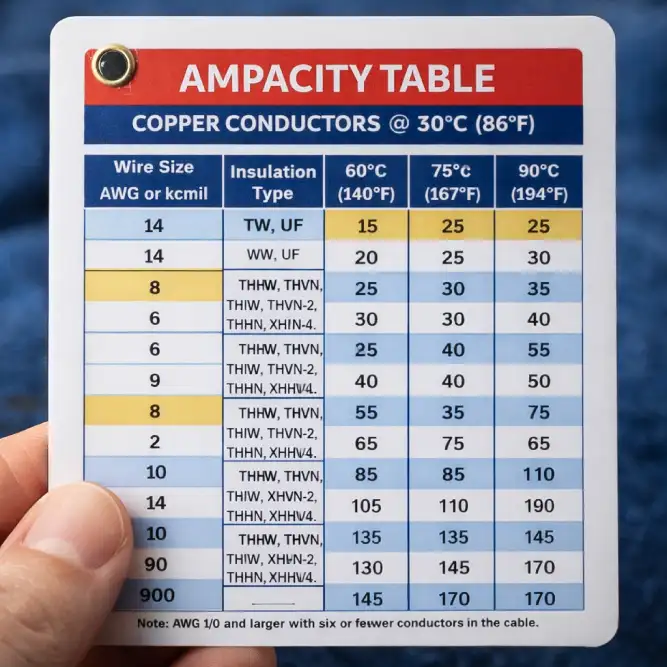
If you have ever sized wire using the NEC, you have probably used Table 310.16. It is one of the most important tables in the entire code book.
The problem is the table looks intimidating the first time you see it. Rows, columns, temperature ratings, copper, aluminum. It can feel like you are reading a spreadsheet from outer space.
In reality it is pretty simple once you know what the pieces mean.
What ampacity actually means
Ampacity just means the maximum current a conductor can safely carry without overheating.
Every wire has a limit. If you push too much current through it, the insulation can break down and the conductor can overheat.
Table 310.16 tells you how many amps a specific wire size can safely handle.
How the table is organized
The table has three main parts electricians care about.
- Wire size on the left
- Temperature rating columns across the top
- Separate rows for copper and aluminum
You find your wire size on the left, then move across to the correct temperature column to see the allowed ampacity.
The temperature columns
Across the top of the table you will see columns for:
- 60°C
- 75°C
- 90°C
These represent the insulation temperature rating of the conductor.
For example, THHN wire is typically rated for 90°C insulation.
But here is the catch that trips people up on exams and in real life.
Many breakers and lugs are rated for 75°C. That means even if the wire insulation is rated for 90°C, you may still have to use the 75°C column when determining ampacity.
Copper vs aluminum
Table 310.16 lists both copper and aluminum conductors.
Copper carries current more efficiently, so the same size copper wire can handle more amps than aluminum.
That is why aluminum feeders are usually one or two sizes larger than copper for the same circuit.
Example using the table
Let’s say you are sizing a copper conductor and the terminals are rated for 75°C.
If you look at the table, a common example is:
- #12 copper in the 75°C column = 25 amps
But because of breaker limits and code rules, #12 copper is usually protected by a 20 amp breaker in normal branch circuits.
That is a perfect example of why the ampacity table is only part of the bigger code picture.
Why electricians memorize parts of this table
After a while most electricians memorize the common sizes because they use them constantly.
For example:
- #14 copper → 15 amp circuits
- #12 copper → 20 amp circuits
- #10 copper → 30 amp circuits
But for larger feeders, services, or exam questions, you will go straight back to Table 310.16.
Studying for the journeyman exam?
Electrician Practice helps you master NEC tables like 310.16 with realistic exam questions and explanations so code questions stop feeling random.