
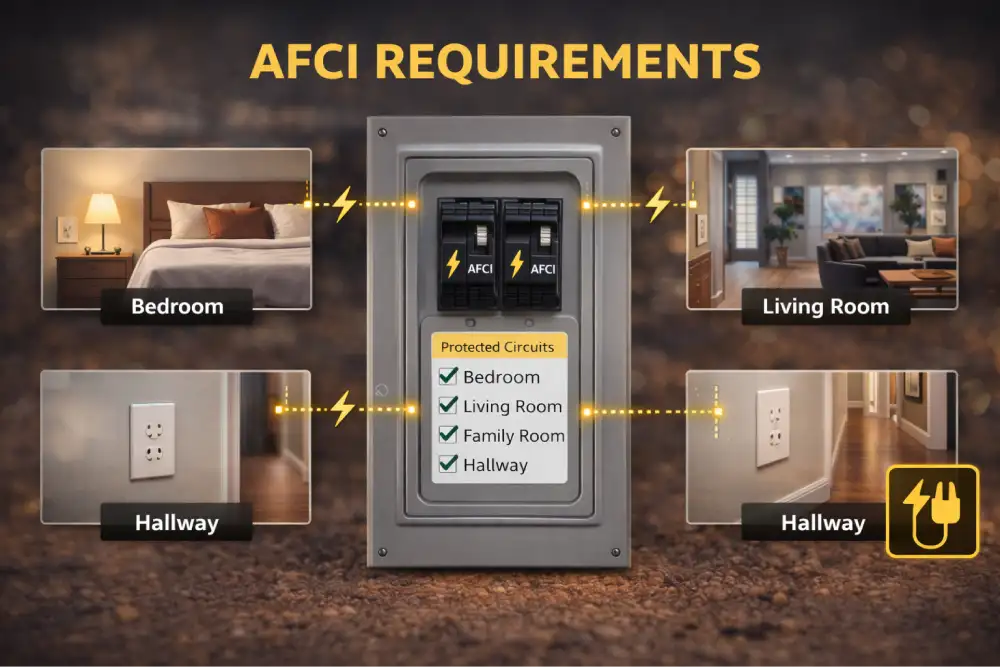
AFCI requirements have expanded a lot over the last few NEC cycles and they catch people off guard on the exam pretty regularly. If you learned the rules a few years ago and have not revisited them, there is a good chance the list of required locations has grown since then.
What an AFCI actually does
A regular breaker trips when there is too much current. An AFCI breaker does something different. It monitors the circuit for the electrical signature of an arc fault, which is what happens when electricity jumps across a gap in damaged or deteriorated wiring.
Arc faults are one of the leading causes of house fires. A wire that has been pinched under a staple, chewed by a rodent, or damaged inside a wall can arc without ever tripping a standard breaker because the current draw might not be high enough to trip it. The AFCI detects that arc pattern and shuts the circuit down before it starts a fire.
Where the NEC requires AFCI protection
Under the 2023 NEC, arc fault circuit interrupter protection is required for 120 volt, 15 and 20 amp branch circuits in all of the following locations in dwelling units:
- Kitchens
- Family rooms
- Dining rooms
- Living rooms
- Parlors
- Libraries
- Dens
- Bedrooms
- Sunrooms
- Recreation rooms
- Closets
- Hallways
- Laundry areas
- Similar rooms or areas
AFCI breaker vs AFCI receptacle
Most of the time AFCI protection is provided at the panel with a combination type AFCI breaker. That one breaker protects the entire circuit from the panel all the way to the last device on the run.
If the panelboard does not support AFCI breakers, the NEC allows an AFCI outlet device to be installed at the first outlet on the branch circuit instead. That outlet then provides protection for the rest of the circuit downstream from it.
The branch circuit wiring between the panel and that first AFCI outlet is not protected by the AFCI in that case, which is worth knowing for the exam.
New construction vs existing work
This is where it gets a little more nuanced in the field.
New construction is straightforward. Any of those listed spaces get AFCI protection, full stop.
For existing work it depends on the situation. If you are extending a circuit or adding an outlet in one of those spaces, most jurisdictions require you to bring the circuit up to current AFCI requirements. Replacing a receptacle on an existing circuit is generally a different story, but adding new wiring usually triggers the requirement.
Always check with the local AHJ because adoption of NEC cycles varies by state and municipality.
The quick version to remember
- AFCI protection is required for 120V, 15 and 20 amp circuits in virtually all finished living spaces
- Bedrooms were the original requirement, the list has expanded significantly in recent NEC cycles
- Protection is usually provided by a combination type AFCI breaker at the panel
- An AFCI outlet device at the first outlet is an alternative when the panel does not support AFCI breakers
- Bathrooms and garages are not on the AFCI list but have GFCI requirements instead
Studying for the journeyman exam?
Electrician Practice covers AFCI and GFCI requirements, NEC code changes, branch circuit rules, and everything else on the exam with realistic practice questions and clear explanations.